
The Samorost project
What is mycocomposite?
Mycelium, or fungal mycelium, is the part of a fungus that remains hidden within its substrate. There it lives its own life, spreading and using its fibers called hyphae to bind and integrate the individual parts of its environment. It is a network of interwoven fungal threads that can grow through soil in systems extending for tens of kilometers. Mycelium can be compared to plant roots, but with a key difference: while roots occupy only a few centimeters of fibers per cubic centimeter of soil, mycelium can contain tens or even hundreds of meters of filaments.
It grows and expands within its environment, searching for any part of the substrate from which it can draw energy and that it can utilize. In doing so, it connects separate elements and forms solid structures. It effectively acts as a natural glue.
Properties of mycelium
From this natural material—first allowed to live, grow, and strengthen, then crushed and shaped—we can create virtually anything. It is not unrealistic to use it as an ecological alternative in construction. This is the type of research we now want to support, to gain clearer insights into how mycelium could be used in the building industry.
A long journey lies ahead of us, full of tests and experiments, ideas, successes, and setbacks. But that is how it should be, and we are entering this new project with that mindset. Follow us and keep your fingers crossed!
For use in construction, the material must undergo professional laboratory testing in areas crucial to the field. Therefore, during the summer of 2023, we subjected the mycocomposite to the necessary tests.
Mycocomposite manufacturing process
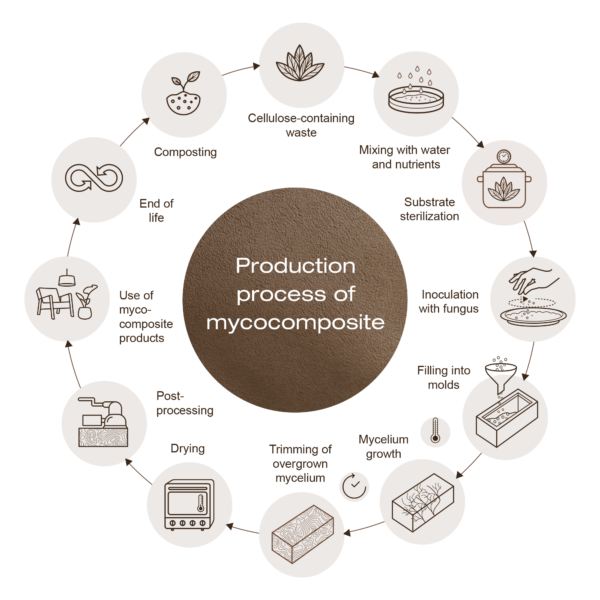
Mycocomposite is a material that is formed by the combination of mycelium and plant waste. Mycelium has the ability to grow through the material and form a solid network of fibres that acts as a natural binder.
1. Initial raw material
The basis is waste material containing cellulose, such as sawdust, straw or paper residue. These raw materials are commonly considered waste, but in this process they acquire new uses.
2. Base material preparation
Plant material is mixed with water and supplemented with the necessary substances to create an environment suitable for mycelium growth.
3. Sterilization
The mixture is sterilized, i.e. stripped of unwanted microorganisms. As a result, mycelium has controlled conditions for growth.
4. Inoculation with mycelium
Mycelium of the selected fungal species is added to the prepared base material. It gradually spreads and grows through the entire volume of material.
5. Formation
The mixture is put into a mould of the desired shape – it can be a panel, block or more complex shape.
6. Growing through
At this stage, the mycelium forms a dense network of fibres that strengthens the material. At the same time, it takes on a shape depending on the mould it is in.
7. Stopping growth
Once the material is grown through with mycelium enough, it strengthens. It is removed from the mould and its further growth is stopped by drying. This deactivates the mycelium and creates a finished, stable material (mycocomposite). It is no longer possible to reactivate dried mycelium (it will not start growing again).
8. Further processing
The resulting mycocomposite can be cut, sanded, surface treated or combined with other materials; for example, it goes well with wood.
9. Use and end of life
At the end of its life, mycocomposite is biodegradable and can be composted. In addition, it can serve as an input raw material for the production of other mycocomposite products, so it can return to the process and continue to be used.
We are thinking of our planet
Waste material is used in the production of mycocomposite, the product can be composted at the end of its life. But what about the burden on the planet in the production of the material itself?
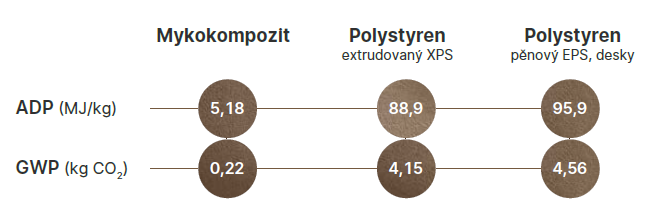
ADP fossil fuels = abiotic depletion potential for fossil resources (characterizes the impact on fossil raw material consumption expressed as the total energy loss of fossil resources; the lower the value, the better the result).
GWP = global warming potential (linked CO2 emissions indicating the equivalent emissions produced over the whole or part of the life cycle of a product causing the greenhouse effect; the lower the value, the better the result).
Data source: LCA product study according to ISO 14040 and 14044, by the CTU, University Centre for Energy Efficient Buildings, September 2024.
Potential of the material
When we started the Samorost project, we only had small panels of mycocomposite in our hands. Gradually, as we tested its properties, limits and possibilities of use, we moved forward. Through the production of interior accessories such as shelves, footstools and tables, we reached the climax of the project. This was the construction of the experimental SAMOROST house. It enabled an examination of the use of mycocomposite on a real architectural scale. It has been shown that mycocomposite can function as a sustainable alternative to commonly used building materials, for example as a substitute for polystyrene, which is not environmentally-friendly, in building insulation.
Where can mycocomposite work?
Mycocomposite is not a universal solution for all types of construction. It has its limits. Today, it makes the most sense where sustainability, working with natural materials and low environmental burdens are emphasized.
It has potential especially for architects, designers and manufacturers who are looking for an alternative to commonly used materials and are open to working with innovative processes. It can also be used by investors and builders who want to use experimental or demonstration projects to verify new approaches in the construction industry.
But it could also appeal to those who want to have something extraordinary at home. In the form of furniture and interior accessories, mycocomposite is transformed into original elements, each of which is unique. The material grows naturally, so there are no two identical pieces. Each has its own shape, structure and character.
The Samorost project shows that mycocomposite can be an interesting choice where there is room for innovation, collaboration and the search for more sustainable solutions.