
The Samorost Project
What do mushrooms have to do with construction?
We supported the Samorost project because it provides a specific answer to this question. Mycocomposite, a mycelium-based material, acts as a natural binding agent that grows through waste raw materials containing cellulose to create a strong, lightweight and insulating structure.
It is made from sawdust, paper or other residual materials that would otherwise remain waste. The result is a self-supporting, thermally insulating and fire-resistant material that can be further worked and composted at the end of its service life.
We wondered if such material could work well outside the laboratory. That is why we have supported research into it, as well as testing and practical use, from insulation boards and acoustic tiles to design elements.
Samorost is a specific experiment for us: we are verifying where mycocomposite has a real place in the construction industry, what its limits are and how it can contribute to reducing buildings’ environmental footprint.
What is Burinka’s role as an initiator of innovation?
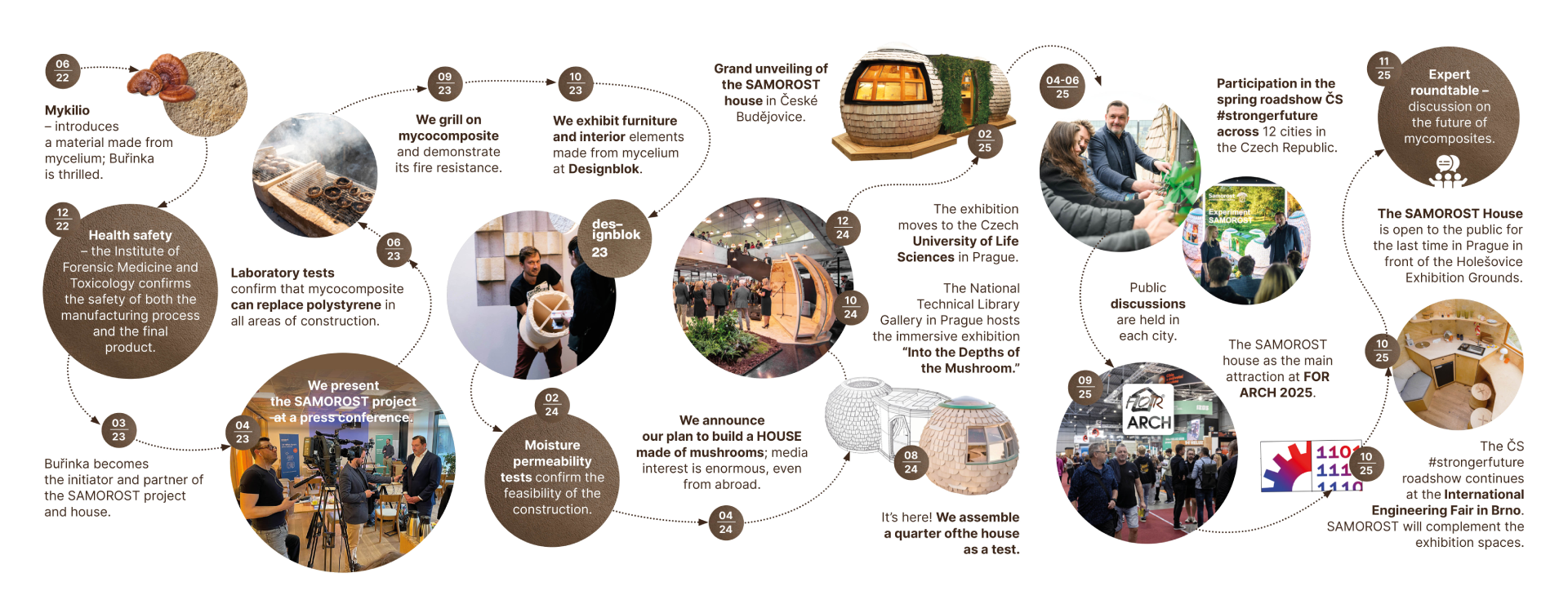
In the Samorost project, we are acting as an initiator and umbrella partner. We brought together researchers, practical experts, architects and designers to create a space for experimentation and sharing knowledge that would otherwise remain enclosed in laboratories or the academic environment. We consciously chose the path of a project that does not lead to a quick product, but to a deeper understanding of innovative material and new sustainable paths.
Samorost was not just a project for us, but an opportunity to verify a new material in real conditions and determine its possibilities and limits. By sharing results, experience, questions and answers, we want to contribute to the expert debate on the future of the construction industry and support the search for more sustainable solutions.
What challenges are we responding to in the construction industry?
- The environmental footprint of traditional materials: The construction industry is a field with high energy and raw material consumption. Traditional materials such as polystyrene and mineral wool are created using fossil raw materials and with a significant emissions burden. Mycocomposite is made from natural raw materials and organic waste, produces significantly lower emissions and has a significantly lower carbon footprint during production than conventional materials.
- Finding sustainable alternative materials Current materials are often not biodegradable and burden the environment after the end of their use in buildings. As a material, mycocomposite offers biodegradability and circularity, which corresponds to the principles of sustainable construction.
- Path from the laboratory to practical use: Most new materials remain in the laboratory or academia for a long time. The Samorost project is trying to apply this knowledge in a real building, the Samorost house, demonstrating that sustainable materials can actually be used in practice.
Contact
Monika KopřivováExternal Communications Manager
Mobile phone: +420 724 087 666
E-mail address: monika.koprivova@burinka.cz